The uncosted backup: hydrogen in the 2050 pathways
hydrogen
storage
adequacy
net-zero
FES
CB7
GB
Both official net-zero pathways lean on a large fleet of deep dispatchable backup — mostly hydrogen, run mostly in winter, costed at zero. And even with that backup burning free, neither keeps the lights on under real weather.
INVESTIGATION · GB-TIER REPRODUCTION
When the wind doesn’t blow and the sun doesn’t shine, Britain needs something else to keep the lights on. Both official 2050 plans answer: hydrogen — burn stored hydrogen in power stations to fill the gaps. The store fills in summer, when solar is strong and demand is low, and drains through winter, when demand is high, solar is gone, and the wind — however strong on average — keeps dropping into cold, still spells for days at a time. It is those winter lulls, not the seasonal average, that the store has to survive.
Research question
Both leading 2050 pathways for Great Britain fill the gaps left by wind and solar with a fleet of deep dispatchable backup. NESO’s FES calls it a hydrogen turbine; the CCC’s CB7 calls it “low-carbon dispatchable” and names no fuel at all. In both, the engine dispatches it as unlimited-fuel firm plant — no fuel cost, no store limit.
Run each pathway against real 2024 weather and ask: how much energy does that backup deliver, what hydrogen store does it imply, and does the system still lose load even with the backup running free?
Method
Run scenarios/fes2025-ee-2050.toml and scenarios/ccc-cb7-bp-2050.toml — the committed published-pathway fleets — under 2024 half-hourly demand and ERA5 weather, single-zone GB, autarkic (no interconnection, adequacy-adverse by construction). Every headline figure is a pinned regression value in the engine’s acceptance suite. The hydrogen monthly profile is derived from the FES dispatch trace.
Result
Both pathways rest on a large deep-backup fleet — and the two official bodies disagree sharply on its size.
| FES 2025 EE 2050 | CCC CB7 2050 | |
|---|---|---|
| Deep-backup label | hydrogen_turbine (named) |
low_carbon_dispatchable (fuel unnamed) |
| Installed backup | 27.52 GW | 38.28 GW |
| Backup energy delivered | 18.2 TWh/yr | 92.0 TWh/yr |
| Fuel chain in the cost stack | none (uncosted) | none (uncosted) |
| Renewable curtailment | 21.6 TWh | 59.0 TWh |
| Unserved energy (lost load) | 0.87 TWh | 5.25 TWh |
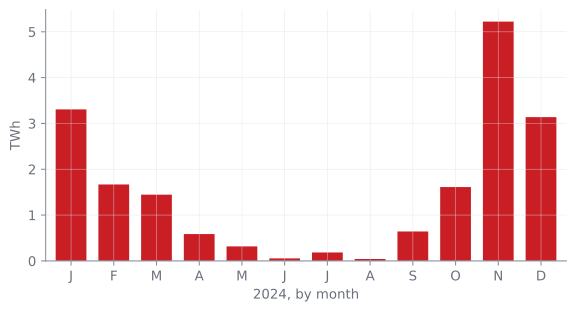
The hydrogen is inter-seasonal, not a peaker. FES’s hydrogen turbine delivers 90 % of its annual energy in October–March — a seasonal store emptied over winter, not a battery cycling daily.
| J | F | M | A | M | J | J | A | S | O | N | D | |
|---|---|---|---|---|---|---|---|---|---|---|---|---|
| TWh | 3.31 | 1.67 | 1.45 | 0.59 | 0.32 | 0.06 | 0.18 | 0.04 | 0.64 | 1.61 | 5.22 | 3.14 |
Implied store. The worst 90-day winter draw is ≈10 TWh of delivered electricity — a hydrogen store of order ≈18 TWh of H₂ (at 55% turbine efficiency) filled over summer and drained over winter, costed at zero. Peak output sits at the full 27.52 GW installed: no headroom at the worst hour.
And it still isn’t enough. Even with the backup treated as unlimited free fuel, both fleets shed firm demand under 2024 weather — 0.87 TWh (FES) and 5.25 TWh (CB7). CB7 curtails 59 TWh of renewables and sheds 5.25 TWh of demand in the same year: surplus and scarcity together, the textbook case for the very store the pathway does not price.
The question, corrected
The question was “hydrogen storage for CB7”. The honest finding is that CB7 names no hydrogen. Its 38.28 GW of deep backup is low_carbon_dispatchable, with — in the scenario’s own words — “no priced fuel chain … a named exclusion”. If that 92 TWh/yr is hydrogen (the only zero-carbon dispatchable fuel at scale), it implies a burn five times FES’s and a far larger store, entirely off the cost line. FES at least names the fuel; neither pathway costs it.
The real sizing: 40 years, one December night
The single-year estimate above is a lower bracket. The honest number comes from sizing a store against the whole weather record. This is a different, deliberately stripped-back grid — wind and solar only, balanced by one hydrogen store, nothing else — run across all 40 years (1985–2024), with the store sized to the smallest capacity that never sheds load. This is the Royal Society’s storage-sizing experiment, reproduced.
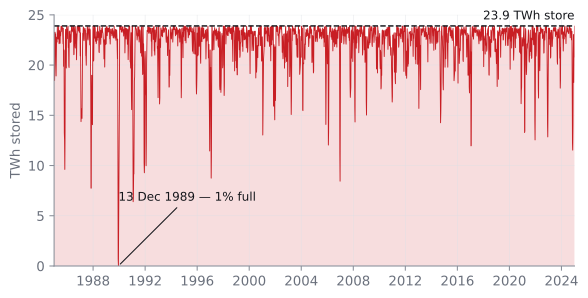
The store has to hold 23.9 TWh — and one moment sizes it. Across 701,280 half-hourly periods, the deepest drawdown is 2am on 13 December 1989, when the store runs down to 0.01 TWh — 1% full. A store any smaller, and the lights go out that night. The 23.9 TWh figure is pinned in the engine’s regression suite (acceptance_stage3_rs37y.rs).
For scale: 23.9 TWh of hydrogen is of order a hundred times Britain’s entire built battery-plus-pumped-storage fleet today. And it is a floor — the 40% round-trip loss, the no-imports assumption, and the fact that 1989 may not be the worst weather the future holds all push the real figure higher.
The grid behind the 40-year chart (grid-cli describe)
Scenario: royal-society-37y  —  wind + solar + hydrogen storage only
Weather: 1985–2024, all 40 years on record (701,280 half-hourly periods), autarkic
Generation (3 technologies, 520.0 GW): offshore_wind 240, onshore_wind 80, solar 200 GW
Storage: hydrogen 100 GW / 23.9 TWh (solved to the zero-unserved requirement), 40% round-trip
Dispatch policy: rule_based
Reproduce it
The headline numbers are pinned regression values — the strongest reproduction path there is:
cargo test -p grid-adequacy --test acceptance_stage7_pathways fes_2050_pins_are_exact
cargo test -p grid-adequacy --test acceptance_stage7_pathways ccc_2050_pins_are_exact
The monthly hydrogen profile regenerates from the FES dispatch trace:
grid-cli run --scenario scenarios/fes2025-ee-2050.toml --out runs/h2-fes
# sum dispatch.csv column `hydrogen_turbine_gw` × 0.5 by calendar month
Note
grid-cli run completes for FES but aborts in pricing for CB7: CB7 keeps no SRMC-bearing plant to bound the price in its unserved periods (scarcity pricing arrives with the cost-synthesis stage). CB7’s adequacy figures come from the acceptance test, which runs the adequacy engine directly. That unserved energy is the finding, not a defect.
Discussion — the honest bracket
- Single weather year. These runs use 2024 only. Store sizing is driven by the worst year in the record, so the ≈18 TWh_H₂ figure is a lower bracket, not a design number. The real figure needs the ERA5 1985–2024 sweep — the key follow-up.
- Autarky is deliberately adverse. No interconnection; real pathways import. This inflates both the backup energy and the unserved — the pessimistic edge.
- Unlimited fuel is favourable. A real hydrogen chain (electrolysis → cavern store → turbine, ~30–40% round-trip) is far more constrained, so the real system is harder to balance than these runs, not easier. The unserved energy is a floor.
- The pathways bracket the fuel question itself. FES commits to hydrogen plus 88 TWh of gas-CCS; CB7 to 92 TWh of unnamed dispatchable plus 60 TWh of nuclear. The 18-vs-92 TWh gap is a real disagreement between the system operator and the statutory adviser about how much deep backup net zero needs.
Conclusion
Both official 2050 pathways rest on a large fleet of deep dispatchable backup that runs mostly in winter, implies an inter-seasonal hydrogen store of order tens of TWh, and is costed at zero. FES names the fuel and leans on ~18 TWh a year; CB7 hides it behind “low-carbon dispatchable” and leans on ~92 TWh. And even with that backup treated as unlimited and free, neither keeps the lights on under a single ordinary weather year. The store — and its cost — is the part of the net-zero grid the pathways leave off the page.
Grid configuration
The two grids these runs describe — generated from the scenarios by grid-cli describe, so they can never drift from the numbers above:
FES 2025 EE 2050 & CCC CB7 2050 fleets (grid-cli describe)
FES 2025 EE 2050  —  demand 784.7 TWh (x2.997 on 2024 shape), 2024 weather, autarkic
  Generation (13 tech, 340.1 GW): offshore_wind 96.4, onshore_wind 50.7, solar 100.9,
    nuclear 21.6, ccgt_ccs 26.6, hydrogen_turbine 27.5, ccgt 4.4, ocgt 2.0, beccs 4.2,
    waste 2.6, hydro 2.2, biomass 1.0, oil 0.1 GW
  Storage: pumped_hydro 16.6 GW / 223 GWh; battery 40.4 GW / 60 GWh
  Dispatch: rule_based

CCC CB7 2050  —  demand 692.0 TWh (electrolysis excluded), 2024 weather, autarkic
  Generation: offshore_wind 125.0, onshore_wind 37.4, solar 106.4, nuclear 11.0,
    low_carbon_dispatchable 38.3 (deep backup, fuel unnamed), beccs 1.3,
    other_generation 5.5 GW
  Storage: pumped_hydro 6.9 GW / 433 GWh; battery 35.1 GW / 139 GWh
  Dispatch: rule_based
The 40-year store-sizing run (the ~24 TWh chart above) is a separate, simpler grid — wind + solar + one hydrogen store, nothing else — with its own config block in that section.
Provenance
- Engine
-
grid-sim
f2e2c17· github.com/grid-modeller/grid-sim - Scenarios
-
scenarios/fes2025-ee-2050.toml·scenarios/ccc-cb7-bp-2050.toml - Pinned tests
-
acceptance_stage7_pathways.rs(fes_2050_pins_are_exact,ccc_2050_pins_are_exact) - Investigation
-
investigations/net-zero-hydrogen-backup/ - Data pack
- GB 2050 pathway pack · Zenodo DOI: pending Phase-0 record
Generated using Copernicus Climate Change Service information (ERA5 weather). Pathway fleets: NESO FES 2025; CCC Seventh Carbon Budget (Balanced Pathway).